SIGN IN
 REGISTER


Monday, 20th July 2026
Tribulus Terrestris
Scientifically proven to increase power
By LA Muscle on 20.07.2026 09:11 am


Tribulus Terrestris is found in:
Tribulus Terrestris: the science of recovery and training performance
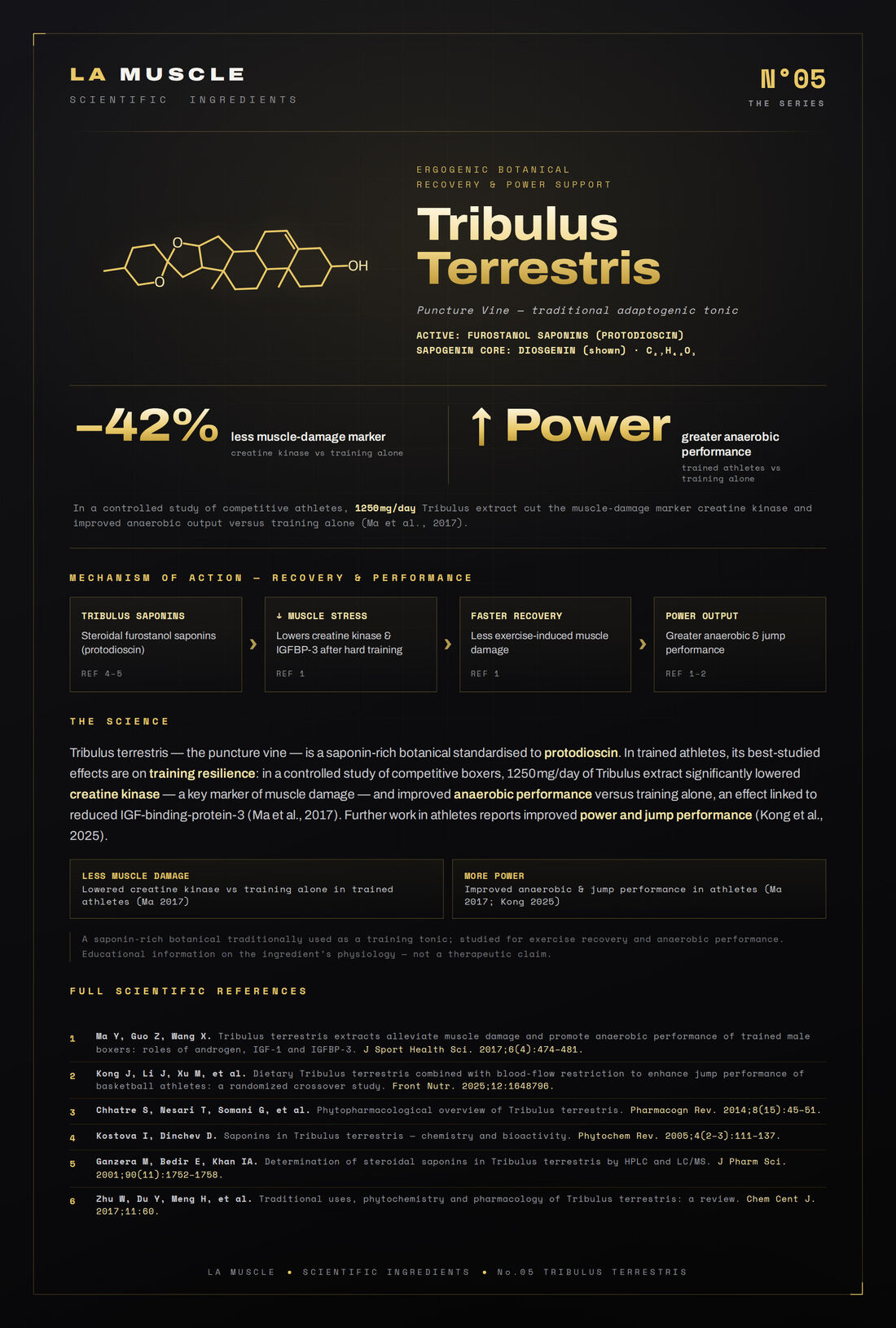
Tribulus terrestris — known as puncture vine — is a traditional adaptogenic botanical prized for centuries in Ayurvedic and Chinese practice. Its activity comes from a family of steroidal furostanol saponins, the best-known of which is protodioscin; the characteristic sapogenin at their core is diosgenin (C27H42O3).
What the research in athletes shows
The most relevant modern research looks at Tribulus in the context of hard training. In a controlled study of competitive boxers, 1250 mg per day of Tribulus extract significantly lowered creatine kinase — a widely used blood marker of muscle damage — and significantly improved anaerobic performance compared with training alone (Ma et al., 2017). In other words, athletes taking Tribulus showed less exercise-induced muscle damage and greater power output across demanding training blocks. More recent work in athletes has reported improvements in power and jump performance when Tribulus is used alongside training (Kong et al., 2025).
Mechanism of action
These training benefits do not appear to be hormonal. In the boxer study, Tribulus did not change muscle mass or testosterone; the reduction in muscle damage was linked instead to a fall in IGF-binding-protein-3 (IGFBP-3), which influences the availability of the muscle-repair factor IGF-1 (Ma et al., 2017). Tribulus's steroidal saponins are also studied for their broader physiological and antioxidant activity (Chhatre et al., 2014; Zhu et al., 2017).The pathway can be summarised as: Tribulus saponins (protodioscin) → lower creatine kinase & IGFBP-3 after hard training → less muscle damage and faster recovery → greater anaerobic power output.
Key facts at a glance
• What it is: Tribulus terrestris (puncture vine), a botanical standardized to steroidal saponins (protodioscin).• Recovery: lowered the muscle-damage marker creatine kinase vs training alone in trained athletes (Ma 2017).
• Performance: improved anaerobic and jump performance alongside training (Ma 2017; Kong 2025).
• Mechanism: linked to reduced IGFBP-3, not to changes in testosterone.
• Category: ergogenic botanical for training recovery and power support.
Full scientific references
• Ma Y, Guo Z, Wang X. Tribulus terrestris extracts alleviate muscle damage and promote anaerobic performance of trained male boxers and its mechanisms: roles of androgen, IGF-1, and IGF binding protein-3. Journal of Sport and Health Science. 2017;6(4):474–481.
• Kong J, Li J, Xu M, Liu T, Xie Z, Li T, Liang Y. Dietary Tribulus terrestris combined with blood flow restriction to enhance the jump performance of basketball athletes: a randomized crossover study. Frontiers in Nutrition. 2025;12:1648796.
• Chhatre S, Nesari T, Somani G, Kanchan D, Sathaye S. Phytopharmacological overview of Tribulus terrestris. Pharmacognosy Reviews. 2014;8(15):45–51.
• Kostova I, Dinchev D. Saponins in Tribulus terrestris — chemistry and bioactivity. Phytochemistry Reviews. 2005;4(2–3):111–137.
• Ganzera M, Bedir E, Khan IA. Determination of steroidal saponins in Tribulus terrestris by HPLC and LC/MS. Journal of Pharmaceutical Sciences. 2001;90(11):1752–1758. • Zhu W, Du Y, Meng H, Dong Y, Li L. Traditional uses, phytochemistry and pharmacology of Tribulus terrestris: a review. Chemistry Central Journal. 2017;11:60.
Tribulus terrestris is a saponin-rich botanical traditionally used as a training tonic and studied for exercise recovery and anaerobic performance. This information is educational and describes the ingredient's physiology and the findings of published research; it is not a therapeutic or medical claim. Individual results vary.






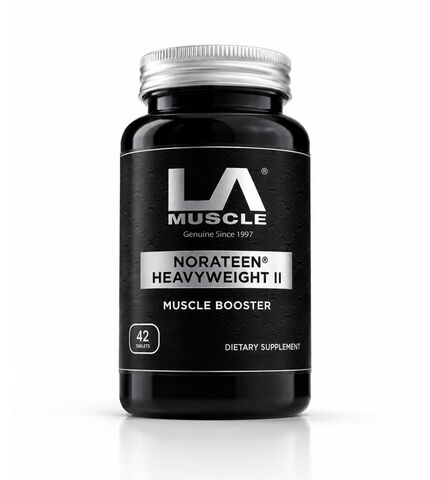
Norateen Heavyweight II
Voted No.1: Men's Health BBC/ SKY TV. No side effects, full guarantee

Norateen Gummy
Incredible, innovative, fast-acting muscle building gummy