SIGN IN
 REGISTER


The Knowledge > How To Build Muscle >
Monday, 11th May 2026
These Bodyweight Exercises Unlock True Inner Strength
By LA Muscle on 11.05.2026 07:14 am


 In an age dominated by machines, fitness apps, expensive gym memberships, and endless supplements, one of the most powerful truths in physical training remains surprisingly simple: your body itself is the greatest training tool you will ever own.
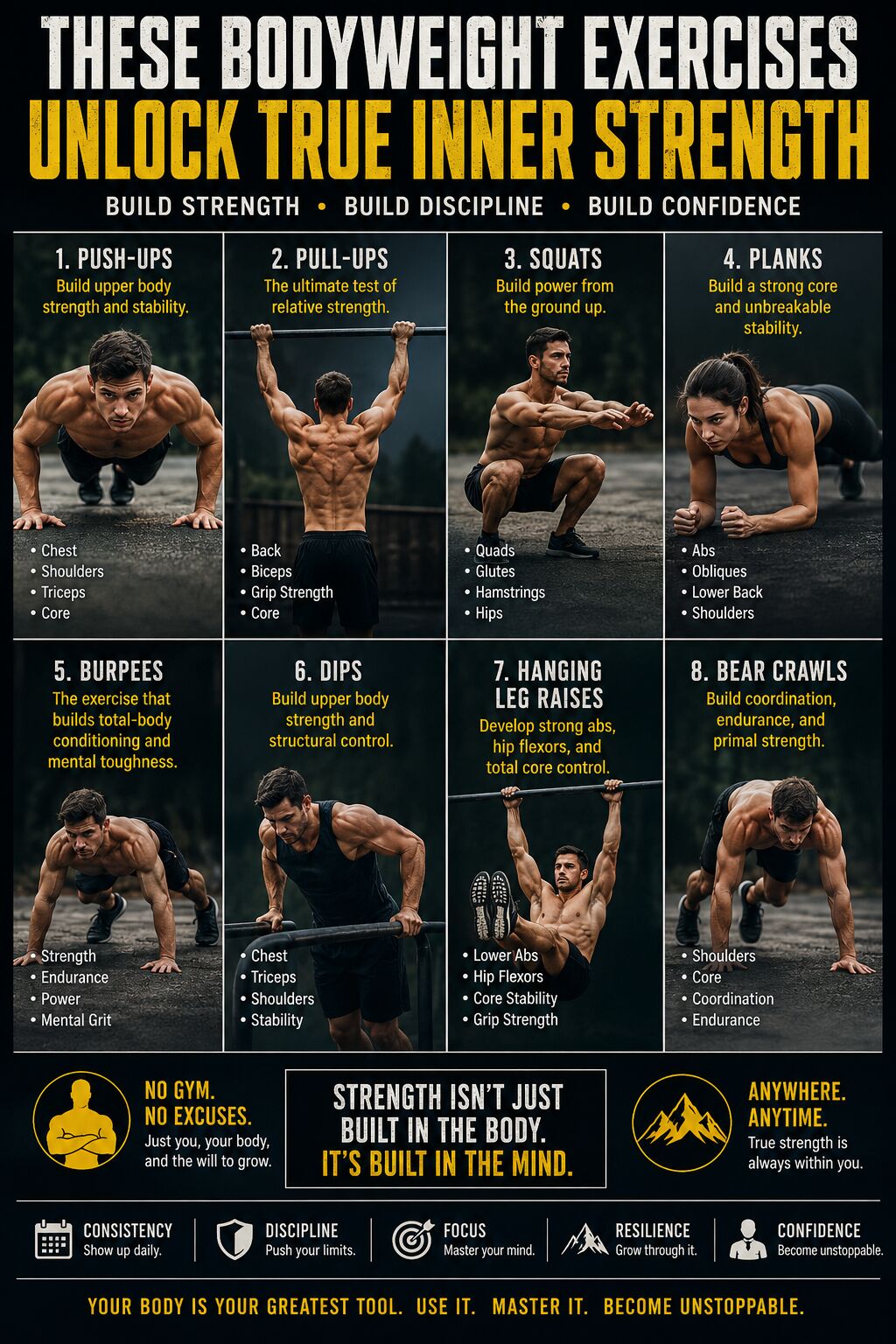
Bodyweight training is not merely a substitute for weights. It is one of the oldest, most effective, and most intelligent systems of physical conditioning ever developed. Long before modern gyms existed, warriors, athletes, gymnasts, martial artists, and military forces built extraordinary levels of strength, resilience, endurance, and mental toughness using nothing more than their own body.
True inner strength is not simply about how much weight a person can lift for one repetition. It is about control. Stability. Coordination. Discipline. Balance. Endurance. Mental resilience. The ability to move your body powerfully and efficiently through space.
The following bodyweight exercises are among the most effective movements for developing genuine functional strength — the kind that translates into real-world physical capability and deep internal confidence.
Why Bodyweight Training Builds Real Strength
Many gym-based exercises isolate muscles. Bodyweight exercises, however, force the body to function as a connected system. They require the nervous system, stabilising muscles, joints, tendons, core, balance, and coordination to work together simultaneously.
This creates several major benefits:
- Greater functional strength
- Improved athleticism
- Better posture
- Increased mobility
- Enhanced muscular endurance
- Stronger connective tissues
- Better body awareness
- Reduced injury risk
- Increased mental resilience
Bodyweight training also develops relative strength — how strong you are in proportion to your own body weight. This is often far more useful than absolute strength in daily life and sport.
A person capable of controlling their own body with precision possesses a level of physical mastery that cannot easily be replicated through machine-based training alone.
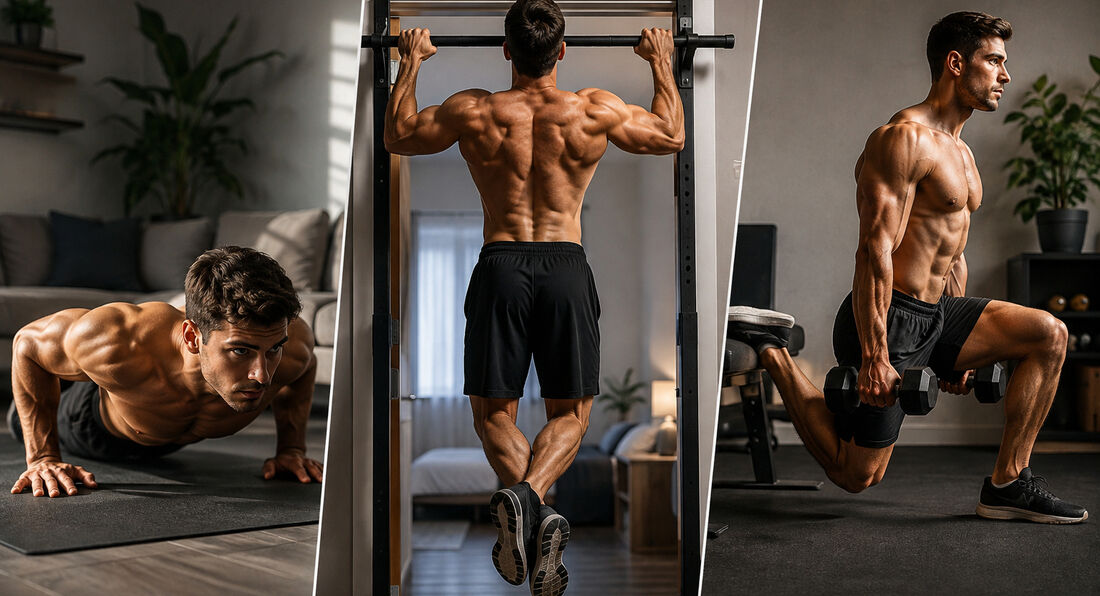
The Push-Up: The Foundation of Upper Body Power
The humble push-up remains one of the greatest strength-building exercises ever created.
Done properly, push-ups develop:
- Chest strength
- Shoulder stability
- Triceps power
- Core activation
- Postural control
- Mental toughness
Most importantly, push-ups teach full-body tension. The body must remain rigid and controlled throughout the movement, turning the exercise into far more than merely a chest workout.
Key Technique
- Hands slightly wider than shoulder width
- Body straight from head to heels
- Core tight throughout
- Lower under control
- Chest close to the floor
- Push explosively upward
Beginners may start on knees or against an incline, while advanced athletes can progress to:
- Archer push-ups
- Diamond push-ups
- Plyometric push-ups
- One-arm push-ups
The one-arm push-up is widely considered one of the greatest demonstrations of practical upper-body bodyweight strength.
Pull-Ups: The Ultimate Test of Relative Strength
Very few exercises reveal true strength as honestly as the pull-up.
Pull-ups build:
- Lats
- Upper back
- Grip strength
- Biceps
- Scapular stability
- Core strength
But beyond muscular development, pull-ups develop determination. They are unforgiving. There is nowhere to hide. Either you can lift your body over the bar — or you cannot.
This brutal honesty is precisely why pull-ups are respected across military units, martial arts, gymnastics, and elite athletics.
Proper Pull-Up Form
- Begin from a dead hang
- Engage shoulders first
- Pull elbows downward
- Avoid swinging excessively
- Chin clears the bar
- Lower under control
If full pull-ups are too difficult initially:
- Use resistance bands
- Perform negatives
- Practise dead hangs
- Build strength with inverted rows
Over time, mastery of pull-ups transforms not only the upper body but also confidence and mental resilience.
Squats: Building Power from the Ground Up
The squat is the king of lower-body movement.
Bodyweight squats strengthen:
- Quadriceps
- Glutes
- Hamstrings
- Core
- Ankles
- Hips
- Knee stability
But more importantly, squats reinforce one of humanity’s most natural movement patterns.
Modern lifestyles have weakened many people’s mobility and posture due to prolonged sitting. Squats help restore natural movement mechanics.
Correct Squat Mechanics
- Feet shoulder width apart
- Chest upright
- Knees tracking naturally
- Hips moving back and down
- Full depth where mobility allows
- Drive upward through the heels
Advanced progressions include:
- Jump squats
- Bulgarian split squats
- Shrimp squats
- Pistol squats
The pistol squat — a one-legged squat performed with balance and control — is among the greatest tests of mobility, coordination, balance, and unilateral strength.
Planks: The Core of Inner Stability
Many people misunderstand core training.
A powerful core is not built through endless sit-ups alone. Real core strength comes from resisting movement and stabilising the spine under tension.
This is precisely what the plank develops.
Planks strengthen:
- Deep abdominal muscles
- Lower back
- Obliques
- Glutes
- Shoulder stabilisers
More importantly, they train endurance of posture and mental control.
Proper Plank Position
- Elbows beneath shoulders
- Body in a straight line
- Core braced tightly
- Glutes engaged
- Neck neutral
- No sagging hips
As endurance improves, progressions include:
- Side planks
- Plank reaches
- RKC planks
- Single-arm planks
Long-duration planks require enormous mental discipline as much as physical endurance.
Burpees: The Exercise That Reveals Mental Toughness
Few exercises test total-body conditioning quite like burpees.
Burpees combine:
- Squats
- Push-ups
- Explosive jumps
- Cardiovascular endurance
- Muscular endurance
They rapidly elevate heart rate while simultaneously challenging coordination and grit.
Burpees are brutally effective because they force the body to continue performing under fatigue — one of the key traits of genuine physical conditioning.
Benefits of Burpees
- Fat burning
- Explosive power
- Cardiovascular fitness
- Full-body conditioning
- Mental resilience
Athletes, military personnel, fighters, and endurance competitors often use burpees because they train both body and mind simultaneously.
Dips: Upper Body Strength and Structural Control
Parallel bar dips are one of the finest exercises for upper-body pressing strength.
Dips strongly activate:
- Chest
- Triceps
- Front deltoids
- Stabilising muscles
Unlike many machine exercises, dips force the body to stabilise naturally throughout the movement.
Proper Dip Execution
- Lower slowly
- Elbows controlled
- Chest slightly forward
- Avoid shoulder collapse
- Push upward powerfully
Advanced athletes often consider weighted dips one of the best upper-body strength exercises available.
Hanging Leg Raises: Total Core Development
Few bodyweight exercises expose weak core strength faster than hanging leg raises.
This movement develops:
- Lower abdominal strength
- Hip flexors
- Grip endurance
- Pelvic control
- Spinal stability
Done correctly, hanging leg raises require tremendous discipline and control rather than momentum.
Key Coaching Points
- Avoid swinging
- Raise legs slowly
- Engage core throughout
- Lower with control
Advanced variations include:
- Toes-to-bar
- Windshield wipers
- L-sits
Gymnasts use these movements extensively because they build exceptional trunk strength and body control.
Bear Crawls: Primitive Strength and Athletic CoordinationBear crawls may appear simple, but they are extraordinarily effective.
This primal movement develops:
- Shoulder endurance
- Core stability
- Coordination
- Cardiovascular fitness
- Joint resilience
Bear crawls reconnect the body to natural locomotion patterns often lost in adulthood.
They also improve contralateral movement — the coordinated interaction between opposite limbs — which is fundamental to athletic performance.
The Psychological Power of Bodyweight Training
One of the greatest advantages of bodyweight training is psychological empowerment.
When individuals learn to control their own body:
- Confidence increases
- Discipline improves
- Mental toughness develops
- Self-reliance grows
There is also freedom in knowing that strength can be built anywhere:
- At home
- Outdoors
- In hotels
- In parks
- While travelling
No machine is required.
No excuses remain.
This simplicity is part of what makes bodyweight training so transformative.
Progression Is the Secret to Continuous Strength
Many people mistakenly believe bodyweight training becomes ineffective after beginner stages. In reality, the opposite is true.
The true power of bodyweight training lies in progression.
Exercises can continually become harder through:
- Increased leverage difficulty
- Single-limb variations
- Explosive movements
- Tempo control
- Isometric holds
- Greater range of motion
Advanced calisthenics athletes demonstrate extraordinary levels of strength through skills such as:
- Muscle-ups
- Front levers
- Human flags
- Planches
- Handstand push-ups
These movements require not only muscle but also neurological efficiency, tendon adaptation, mobility, balance, and immense discipline.
The Connection Between Physical and Inner Strength
There is a profound psychological transformation that occurs when people master difficult bodyweight movements.
Each repetition teaches:
- Persistence
- Self-control
- Patience
- Resilience
- Focus
Unlike passive machine training, bodyweight training demands full engagement. It teaches individuals to overcome discomfort and develop mastery over themselves.
This is why bodyweight training has been embraced throughout history by:
- Martial artists
- Soldiers
- Gymnasts
- Fighters
- Yogis
- Athletes
- Special forces units
True inner strength is never purely physical. It is the combination of physical capability, mental resilience, and disciplined self-control.
So, this is it
Bodyweight exercises are far more than a fitness trend. They are a timeless system for developing authentic strength from the inside out.
Push-ups build pressing power.
Pull-ups build determination.
Squats create foundational strength.
Planks develop stability.
Burpees forge endurance.
Dips build control.
Leg raises create core mastery.
Bear crawls reconnect primal athleticism.
Together, these movements cultivate something deeper than muscle alone. They develop the rare ability to command your own body with strength, precision, resilience, and confidence. And that is where true inner strength begins.






Vasculator EXTREME
2 months' supply of very powerful gym muscle pills

Six Pack Pill® Extreme
Guaranteed six pack or money back, NO RISK results typically in days