SIGN IN
 REGISTER


Wednesday, 6th May 2026
Creatine in 2026
One of the Most Advanced Performance and Health Nutrients on Earth
By LA Muscle on 06.05.2026 06:20 pm


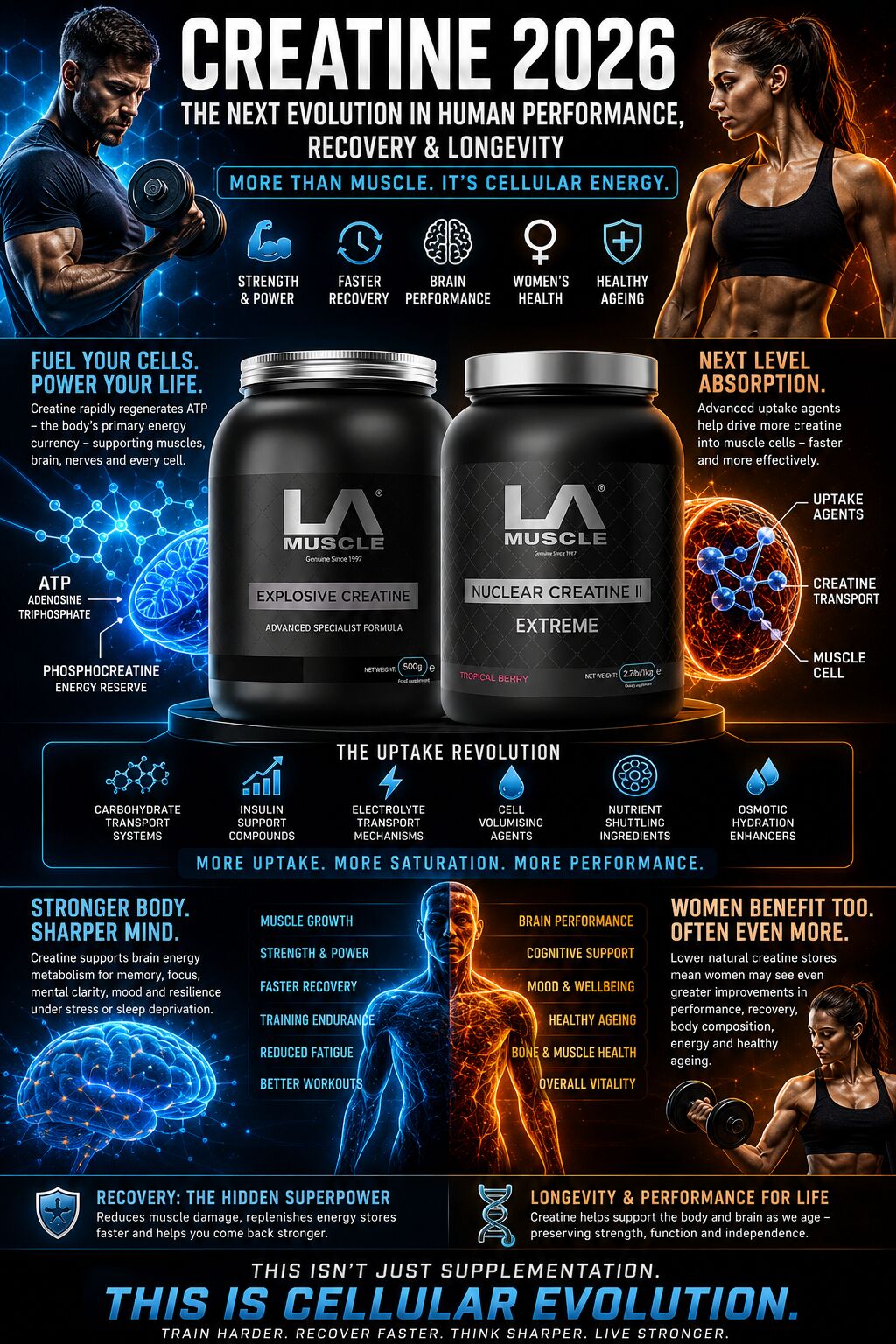
For years, creatine was unfairly labelled as “just a bodybuilding supplement.” In 2026, that idea has completely changed. Today, creatine is being studied not only for muscle growth and strength, but also for brain function, recovery, healthy ageing, mood, cognitive performance, energy production, women’s health, and even neurological resilience. Scientists now see creatine as a full-body cellular energy compound — not merely a gym product. And the biggest shift in the industry is not simply whether creatine works. It is how effectively it gets delivered into muscle and brain cells. That is where next-generation formulas such as Explosive Creatine and Nuclear Creatine are changing the game.
Creatine Is No Longer Just About Muscle
The core reason creatine works is simple:
Your body runs on ATP — adenosine triphosphate — the immediate energy currency used by muscles, the brain, nerves, and cells. Creatine helps rapidly regenerate ATP during high-demand activity.
That means more power.
More output.
More recovery.
More performance.
Scientists now describe creatine as a “cellular energy buffer” that supports both muscular and neurological energy systems. In practical terms, this means creatine may help support:
- Muscle growth
- Strength and power
- Faster recovery
- Reduced fatigue
- Training endurance
- Brain energy metabolism
- Cognitive performance
- Mood support
- Healthy ageing
- Bone and muscle preservation in older adults
- Sleep deprivation resilience
- Exercise performance in women
The Brain Benefits Are One of the Biggest 2026 Discoveries
One of the most exciting areas of modern creatine research is cognition.
Newer studies suggest creatine may support:
- Memory
- Processing speed
- Mental clarity
- Attention
- Mood
- Cognitive resilience under stress or sleep deprivation
Researchers now believe the brain may benefit from improved phosphocreatine availability in a similar way to muscle tissue.
This is why creatine is now being discussed not only in gyms — but also in neuroscience and healthy ageing circles.
Why Women May Benefit Even More Than Men
Another major change in the science is the growing recognition that women may respond exceptionally well to creatine supplementation.
Historically, most creatine studies were performed on men. That is changing rapidly.
New research suggests women often have lower natural creatine stores, meaning supplementation may produce even more noticeable effects.
Emerging evidence suggests creatine may help women with:
- Lean muscle tone
- Exercise performance
- Recovery
- Energy
- Cognitive support
- Mood
- Healthy ageing
- Menopause-related muscle decline
The outdated myth that creatine is “only for male bodybuilders” has now completely collapsed.
Recovery: The Hidden Superpower of Creatine
Most people think creatine only helps during workouts.
But modern evidence suggests one of its greatest advantages may actually be recovery.
Studies now indicate creatine may help:
- Reduce exercise-induced muscle damage
- Support faster phosphocreatine replenishment
- Reduce fatigue
- Improve recovery between training sessions
- Support muscle repair and training adaptation
This means better performance not only today — but again tomorrow. For athletes, busy professionals, parents, and ageing adults alike, recovery capacity is becoming one of the most valuable aspects of supplementation.
Why Standard Creatine Is No Longer the Endgame
Traditional creatine monohydrate still works extremely well. But the biggest advancement in 2026 is delivery technology. Scientists now recognise that not all creatine is utilised equally.
Absorption.
Transport.
Cellular uptake.
Hormone signalling.
Muscle saturation.
Transport efficiency.
These factors all influence how effectively creatine reaches muscle cells.
That is why advanced formulas containing specialised uptake agents are becoming increasingly popular.
Why Advanced Formulas Like Explosive Creatine and Nuclear Creatine Stand Out
Products such as Explosive Creatine and Nuclear Creatine represent the evolution of creatine supplementation. Rather than relying purely on plain creatine alone, these next-generation systems include specialised transport and uptake technologies designed to:
- Enhance absorption
- Improve cellular delivery
- Accelerate saturation
- Increase muscular uptake
- Improve nutrient partitioning
- Support greater performance output
The idea is simple:
If more creatine reaches the muscle cell faster and more efficiently, the user may experience:
- Faster strength gains
- Better pumps
- Improved endurance
- Greater training intensity
- Faster recovery
- More noticeable physical changes
Advanced uptake systems aim to overcome the limitations of ordinary creatine powders.
The “Uptake Agent” Revolution
Modern high-performance creatine formulas increasingly combine creatine with compounds that may enhance transport into muscle tissue. These uptake technologies can include:
- Carbohydrate transport systems
- Hormone-support compounds
- Electrolyte transport mechanisms
- Cell volumising agents
- Nutrient shuttling ingredients
- Osmotic hydration enhancers
Research has shown creatine uptake may improve when combined with ingredients that support nutrient transport and hormone response. Advanced formulas take this concept further. The goal is not simply taking creatine. The goal is driving more of it into the muscle cell where it can actually perform. That is the future of sports nutrition.
Why Creatine Has Become a Longevity Supplement
Perhaps the most fascinating development is that creatine is no longer viewed solely as a sports supplement. Many scientists now view it as a healthy ageing and performance-preservation nutrient. Why?
Because ageing itself is strongly associated with declining:
- Cellular energy production
- Muscle mass
- Recovery capacity
- Brain energy metabolism
- Strength
- Cognitive resilience
Creatine directly targets the body’s energy systems.
That is why researchers are now studying its role in:
- Age-related muscle loss
- Cognitive ageing
- Fatigue
- Neurological support
- Functional performance in older adults
In 2026, creatine has evolved from “gym powder” into one of the most scientifically respected performance and wellness compounds available.
The science on creatine has changed dramatically.
What was once considered a niche bodybuilding supplement is now recognised as a multi-functional cellular energy compound with benefits that may extend far beyond muscle. Modern research suggests creatine may support:
- Strength
- Muscle growth
- Recovery
- Brain performance
- Mood
- Cognitive function
- Healthy ageing
- Women’s health
- Athletic performance
And as delivery science evolves, advanced formulations such as Explosive Creatine and Nuclear Creatine are pushing creatine technology into a new era through sophisticated uptake and transport systems designed to maximise effectiveness. In 2026, creatine is no longer just about building muscle. It is about powering the human body — and brain — at a cellular level.








Fat Stripper
Stimulant-free, natural fat burner with no side effects, lose weight NOW!
Norateen Diamond
Build Muscle AND Lose Weight, Diamond Cuts