SIGN IN
 REGISTER


Saturday, 18th July 2026
D-Aspartic Acid
Scientifically Proven to increase Testosterone
By LA Muscle on 18.07.2026 10:40 am


D-Aspartic Acid is found in:
D-Aspartic Acid: the science behind testosterone, muscle and strength
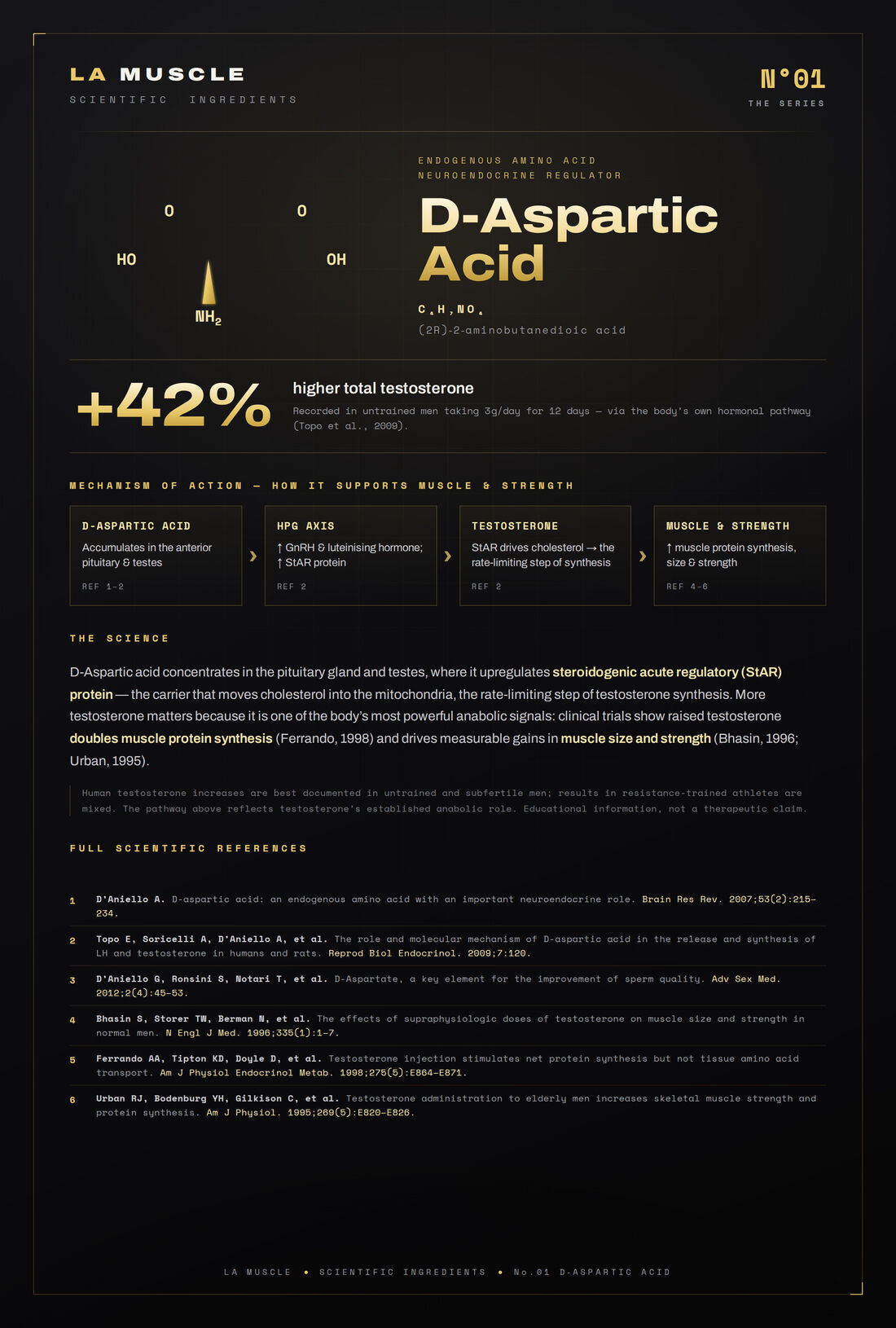
D-Aspartic acid (DAA) is a naturally occurring amino acid — the D-enantiomer of aspartic acid, chemical formula C4H7NO4, IUPAC name (2R)-2-aminobutanedioic acid. Unlike the amino acids used simply as protein building blocks, DAA works as a signalling molecule in the body's neuroendocrine tissues — concentrating in the pituitary gland and the testes, where it helps regulate the production of testosterone.
Mechanism of action: how D-Aspartic acid works
D-Aspartic acid acts on the hypothalamic-pituitary-gonadal (HPG) axis at multiple points. It stimulates the release of gonadotropin-releasing hormone (GnRH) and luteinising hormone (LH), and — importantly — it upregulates steroidogenic acute regulatory (StAR) protein in the testes. StAR controls the transport of cholesterol into the mitochondria, which is the rate-limiting step of testosterone synthesis. By boosting this step, DAA supports the body's own production of testosterone (Topo et al., 2009; D'Aniello, 2007).The pathway can be summarised as: D-Aspartic acid → ↑ LH & StAR protein → ↑ testosterone synthesis → ↑ muscle protein synthesis, size and strength.
The testosterone–muscle connection
Testosterone is one of the body's most powerful anabolic signals, and its role in building muscle is exceptionally well established in clinical research. Testosterone administration has been shown to double the rate of muscle protein synthesis (Ferrando et al., 1998), to increase skeletal muscle strength and protein synthesis (Urban et al., 1995), and — in a landmark New England Journal of Medicine trial — to significantly increase muscle size and strength, with effects that are additive to resistance training (Bhasin et al., 1996). This is the mechanistic reason DAA is valued as a natural testosterone-support ingredient by athletes and bodybuilders.
What the evidence shows — and where it's strongest
Early human research found that 3 g per day of D-aspartic acid raised total testosterone by roughly 42% in participants over 12 days (Topo et al., 2009). The clearest testosterone responses in human studies are seen in untrained men and in men with reduced fertility; findings in already resistance-trained athletes have been more mixed. In short, the mechanism is well characterised and the testosterone data are genuine, with the strongest human evidence in untrained and subfertile populations. DAA is an amino acid that works with your natural hormonal pathway — not a hormone or steroid.
Key facts at a glance
• What it is: an endogenous amino acid (the D-form of aspartic acid), C4H7NO4.
• Where it acts: the pituitary gland and testes, via the HPG axis.
• Mechanism: upregulates StAR protein → cholesterol transport → the rate-limiting step of testosterone synthesis.
• Why it matters for muscle: testosterone drives muscle protein synthesis, size and strength (Bhasin 1996; Ferrando 1998; Urban 1995).
• Best-evidenced result: ~42% higher testosterone in untrained men at 3 g/day (Topo 2009).
• Category: natural testosterone support — not a hormone or steroid.
Full scientific references
• D'Aniello A. D-aspartic acid: an endogenous amino acid with an important neuroendocrine role. Brain Research Reviews. 2007;53(2):215–234.
• Topo E, Soricelli A, D'Aniello A, Ronsini S, D'Aniello G. The role and molecular mechanism of D-aspartic acid in the release and synthesis of LH and testosterone in humans and rats. Reproductive Biology and Endocrinology. 2009;7:120.
• D'Aniello G, Ronsini S, Notari T, et al. D-Aspartate, a key element for the improvement of sperm quality. Advances in Sexual Medicine. 2012;2(4):45–53.
• Bhasin S, Storer TW, Berman N, et al. The effects of supraphysiologic doses of testosterone on muscle size and strength in normal men. New England Journal of Medicine. 1996;335(1):1–7.
• Ferrando AA, Tipton KD, Doyle D, Phillips SM, Cortiella J, Wolfe RR. Testosterone injection stimulates net protein synthesis but not tissue amino acid transport. American Journal of Physiology-Endocrinology and Metabolism. 1998;275(5):E864–E871.
• Urban RJ, Bodenburg YH, Gilkison C, et al. Testosterone administration to elderly men increases skeletal muscle strength and protein synthesis. American Journal of Physiology. 1995;269(5):E820–E826.
This information is provided for educational purposes and describes the physiological role of the ingredient and the established biology of testosterone; it is not a therapeutic or medical claim. Individual results vary.







Norateen Black
World's First Norateen® Muscle Builder AND Fat Burner In One

Fat Stripper Intense Gummy
Instant-acting appetite reduction and fat burning