SIGN IN
 REGISTER


Sunday, 19th July 2026
Creatine
Scientifically proven to increase lifting by 14%
By LA Muscle on 19.07.2026 11:00 am


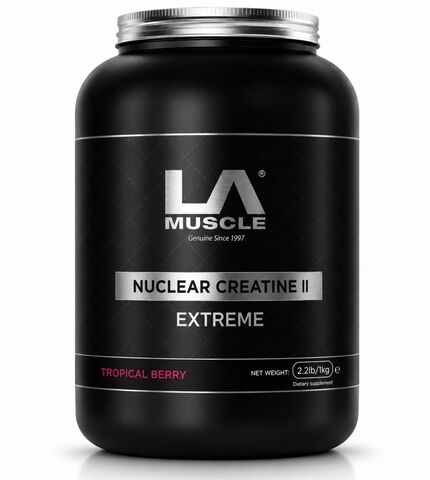
Creatine can be found in:
Creatine Monohydrate: the most-proven ingredient for strength and muscle
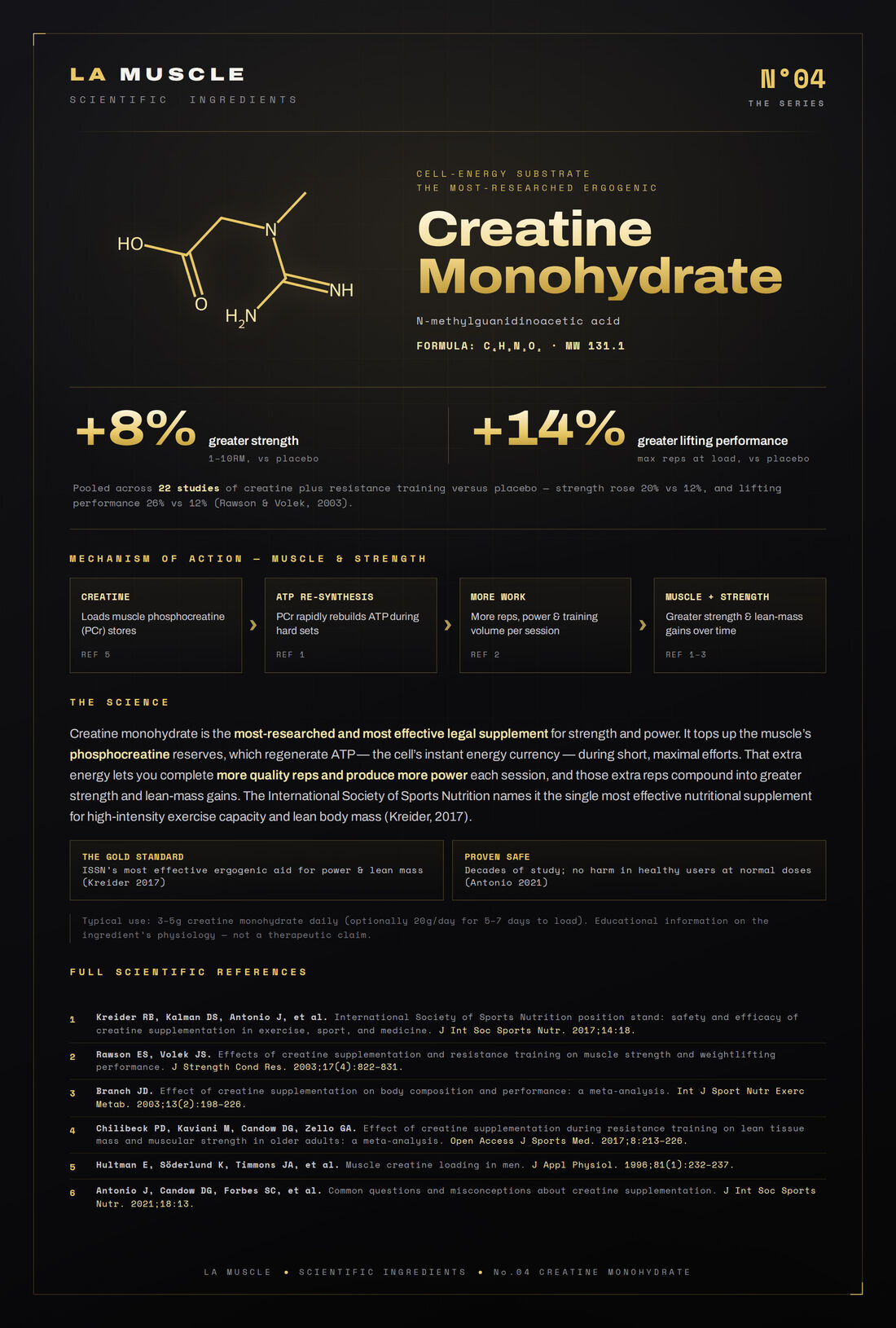
Creatine monohydrate (chemically N-methylguanidinoacetic acid, formula C4H9N3O2, molecular weight 131.1) is the most-researched and most effective legal supplement in all of sports nutrition. Hundreds of peer-reviewed trials and multiple meta-analyses support its ability to increase strength, power and lean muscle mass when combined with resistance training.Mechanism of action: more energy for every hard set
Creatine works by topping up the muscle's stores of phosphocreatine (PCr). During short, maximal efforts — a heavy set, a sprint, an explosive jump — your muscles burn through ATP, their immediate energy currency, within seconds. Phosphocreatine rapidly regenerates that ATP, so higher PCr stores mean you can sustain more reps, more power and more total training volume in each session (Hultman et al., 1996; Kreider et al., 2017). Over weeks and months, those extra quality reps compound into greater strength and lean-mass gains.The pathway can be summarised as: creatine → loads muscle phosphocreatine → rapid ATP re-synthesis → more reps & power per session → greater strength and lean muscle.
The evidence
A landmark review of 22 studies found that creatine combined with resistance training produced, on average, ~8% greater gains in muscle strength (a 20% increase versus 12% on placebo) and ~14% greater gains in weightlifting performance (26% versus 12% on placebo); increases in bench-press one-rep-max ranged as high as 45% in individual studies (Rawson & Volek, 2003). Meta-analyses confirm consistent benefits for strength and lean tissue mass across ages and training levels (Branch, 2003; Chilibeck et al., 2017). The International Society of Sports Nutrition, in its official position stand, describes creatine as the single most effective nutritional supplement available for increasing high-intensity exercise capacity and lean body mass during training (Kreider et al., 2017).Safe and simple to use
Creatine monohydrate has one of the strongest safety records of any supplement: decades of research show no harmful effects in healthy people at recommended doses, and it does not damage the kidneys or liver in healthy users (Antonio et al., 2021). A typical protocol is 3–5 g per day; an optional loading phase of around 20 g per day (split into 4 doses) for 5–7 days saturates the muscles faster.Key facts at a glance
• What it is: creatine monohydrate, C4H9N3O2 — the most-studied sports supplement. • Mechanism: loads muscle phosphocreatine to rapidly regenerate ATP during intense effort. • Strength: ~8% greater strength gains vs placebo with resistance training (Rawson & Volek 2003).• Performance: ~14% greater weightlifting performance vs placebo (Rawson & Volek 2003).
• Status: ISSN's most effective ergogenic aid for power and lean mass (Kreider 2017).
• Dose: 3–5 g daily; optional 20 g/day loading for 5–7 days.
Full scientific references
• Kreider RB, Kalman DS, Antonio J, et al. International Society of Sports Nutrition position stand: safety and efficacy of creatine supplementation in exercise, sport, and medicine. Journal of the International Society of Sports Nutrition. 2017;14:18.
• Rawson ES, Volek JS. Effects of creatine supplementation and resistance training on muscle strength and weightlifting performance. Journal of Strength and Conditioning Research. 2003;17(4):822–831.
• Branch JD. Effect of creatine supplementation on body composition and performance: a meta-analysis. International Journal of Sport Nutrition and Exercise Metabolism. 2003;13(2):198–226.
• Chilibeck PD, Kaviani M, Candow DG, Zello GA. Effect of creatine supplementation during resistance training on lean tissue mass and muscular strength in older adults: a meta-analysis. Open Access Journal of Sports Medicine. 2017;8:213–226.
• Hultman E, Söderlund K, Timmons JA, Cederblad G, Greenhaff PL. Muscle creatine loading in men. Journal of Applied Physiology. 1996;81(1):232–237.
• Antonio J, Candow DG, Forbes SC, et al. Common questions and misconceptions about creatine supplementation: what does the scientific evidence really show? Journal of the International Society of Sports Nutrition. 2021;18:13.
This information is educational and describes the ingredient's physiology and the findings of published research; it is not a therapeutic or medical claim. Individual results vary.





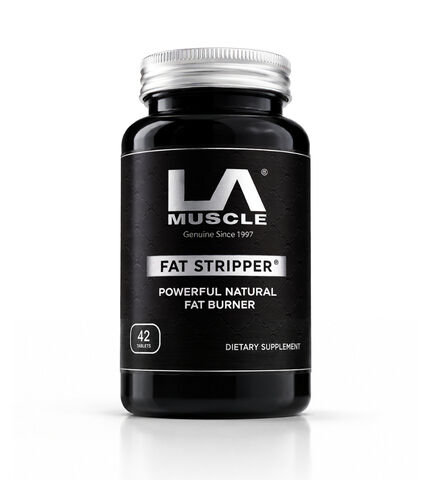
Fat Stripper
Stimulant-free, natural fat burner with no side effects, lose weight NOW!
LA Whey Gold Protein
Voted "Best for Hard Gainers", Now with FREE Leaning agents, 50g per serving