SIGN IN
 REGISTER


Saturday, 18th July 2026
Suma Root
Scientifically Proven Lean Muscle Builder
By LA Muscle on 18.07.2026 01:33 pm


Suma Root Can be found in:
Suma Root: the non-androgenic muscle-building science of beta-ecdysterone
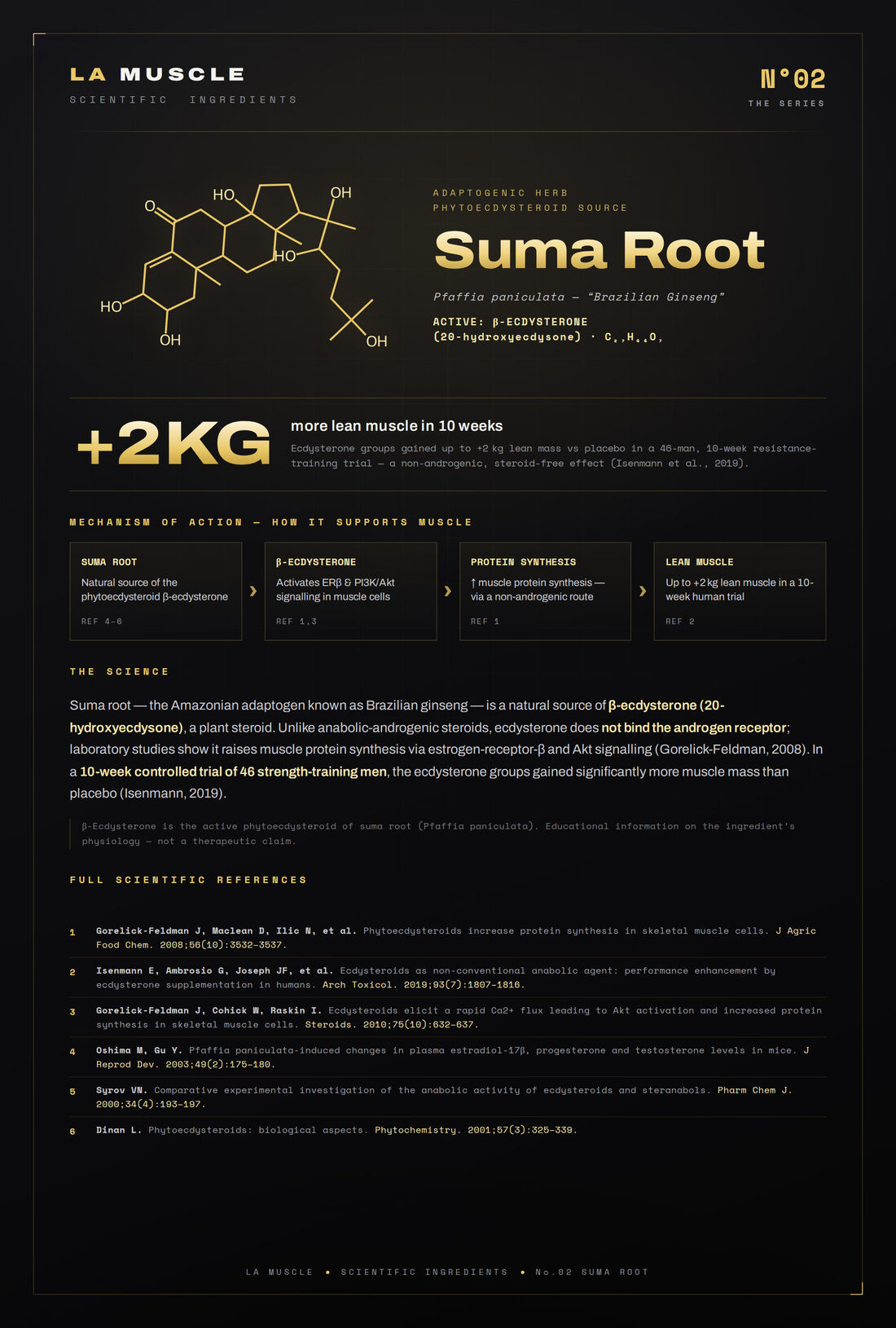
Suma root (Pfaffia paniculata), the Amazonian vine known as "Brazilian ginseng," is a traditional adaptogen — the locals call it para tudo, "for everything." For strength athletes, its interest lies in one active compound: beta-ecdysterone (20-hydroxyecdysone), a naturally occurring plant steroid with the formula C27H44O7. Suma root is a natural botanical source of this phytoecdysteroid.
Mechanism of action: anabolic without the androgen receptor
What makes beta-ecdysterone unusual is how it works. Unlike anabolic-androgenic steroids, ecdysterone does not bind the androgen receptor. Laboratory research on skeletal muscle cells shows it instead increases muscle protein synthesis through estrogen-receptor-beta (ERβ) and the PI3K/Akt signalling pathway, with a rapid calcium flux triggering Akt activation (Gorelick-Feldman et al., 2008; 2010). In practical terms, that means an anabolic, muscle-supporting action without the androgenic side-effect profile associated with steroids.The pathway can be summarised as: Suma root → beta-ecdysterone → ERβ & Akt activation → ↑ muscle protein synthesis → lean-muscle gains.
What the human research shows
The most rigorous human evidence comes from a 2019 study at the German Sport University Cologne and Freie Universität Berlin. In a 10-week resistance-training trial of 46 young men, participants who supplemented ecdysterone gained up to +2 kg more lean muscle mass than the placebo group (roughly +1.5 kg on the lower dose and +2 kg on the higher dose); the same hypertrophic effect was reproduced in cultured muscle cells. The effect was pronounced enough that the authors recommended ecdysterone be reviewed by anti-doping authorities as a potential anabolic agent (Isenmann et al., 2019). Earlier animal work also found that suma root raised testosterone levels in mice (Oshima & Gu, 2003).
Key facts at a glance
• What it is: Suma root (Pfaffia paniculata), an adaptogenic Amazonian herb, "Brazilian ginseng."
• Active compound: beta-ecdysterone (20-hydroxyecdysone), a phytoecdysteroid, C27H44O7.
• Mechanism: raises muscle protein synthesis via ERβ / Akt signalling — not via the androgen receptor.
• Human evidence: up to +2 kg more lean muscle over 10 weeks of strength training vs placebo (Isenmann 2019).
• Category: natural, non-androgenic anabolic support and adaptogen — not a hormone or steroid drug.
Full scientific references
• Gorelick-Feldman J, Maclean D, Ilic N, et al. Phytoecdysteroids increase protein synthesis in skeletal muscle cells. Journal of Agricultural and Food Chemistry. 2008;56(10):3532–3537.
• Isenmann E, Ambrosio G, Joseph JF, et al. Ecdysteroids as non-conventional anabolic agent: performance enhancement by ecdysterone supplementation in humans. Archives of Toxicology. 2019;93(7):1807–1816.
• Gorelick-Feldman J, Cohick W, Raskin I. Ecdysteroids elicit a rapid Ca2+ flux leading to Akt activation and increased protein synthesis in skeletal muscle cells. Steroids. 2010;75(10):632–637. • Oshima M, Gu Y. Pfaffia paniculata-induced changes in plasma estradiol-17β, progesterone and testosterone levels in mice. Journal of Reproduction and Development. 2003;49(2):175–180.
• Syrov VN. Comparative experimental investigation of the anabolic activity of ecdysteroids and steranabols. Pharmaceutical Chemistry Journal. 2000;34(4):193–197.
• Dinan L. Phytoecdysteroids: biological aspects. Phytochemistry. 2001;57(3):325–339.
Beta-Ecdysterone is the active phytoecdysteroid of suma root, traditionally valued as an adaptogen. This information is educational and describes the ingredient's physiology; it is not a therapeutic or medical claim. Individual results vary.








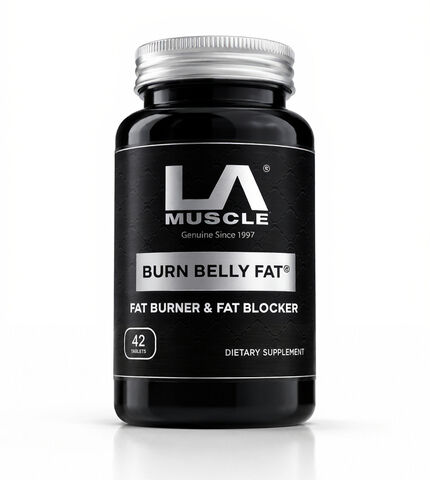
Burn Belly Fat
Fast-action natural fat burner for men & women

Possessed II
The STRONGEST Pre-Workout in the world. Insanity from day 1