SIGN IN
 REGISTER


The Knowledge > How To Build Muscle >
Friday, 13th March 2026
What Is the Hollow Hold and How It Helps Your Muscle Building and Fitness Goals
By LA Muscle on 13.03.2026 11:44 am


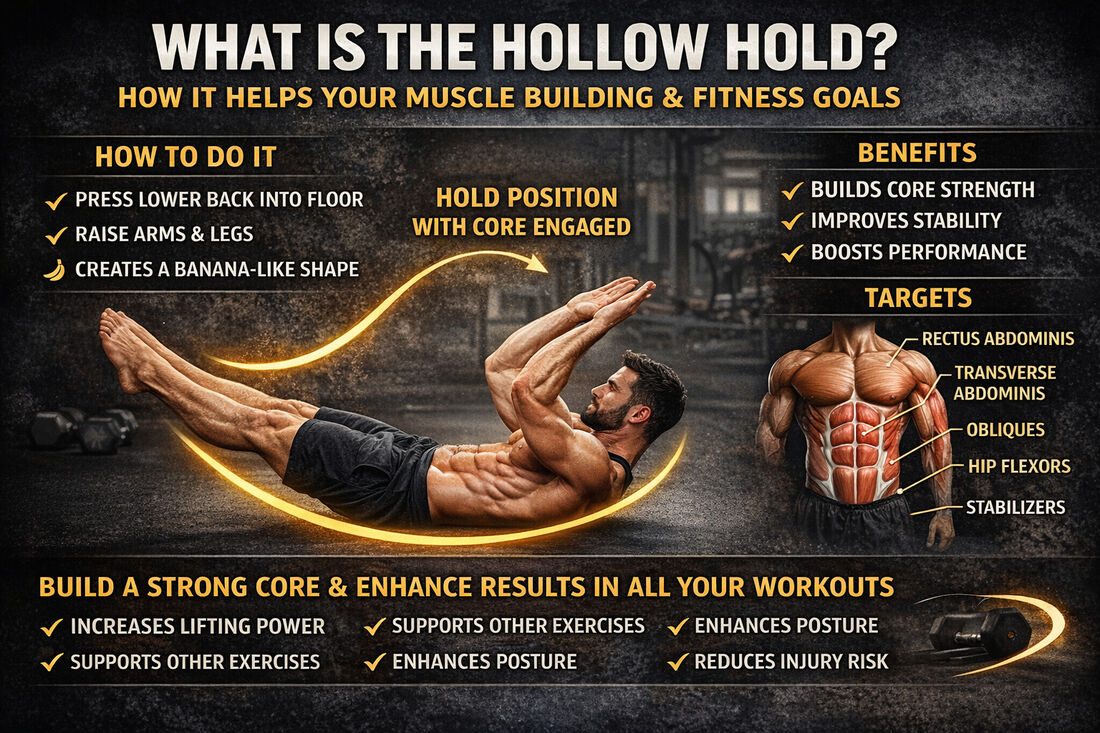
The hollow hold is a simple but extremely powerful core exercise used by gymnasts, athletes, and strength trainers. It involves holding your body in a curved “hollow” position while lying on your back, with your core muscles fully engaged. Although it may look easy, the hollow hold is one of the most effective exercises for building a strong, stable core, which plays a critical role in almost every athletic movement and strength exercise. A strong core improves posture, balance, lifting performance, and injury prevention, making the hollow hold a valuable addition to almost any training routine.
What the Hollow Hold Is
The hollow hold is an isometric exercise, meaning you hold a position without moving while your muscles remain under constant tension. In this exercise, your body forms a slightly curved shape, with your lower back pressed firmly into the floor while your arms and legs are lifted slightly off the ground. This position forces the abdominal muscles to work continuously to stabilise your spine and keep your body controlled. The key idea is to create total body tension while maintaining a strong, stable core.
Muscles Worked in the Hollow Hold
The hollow hold primarily targets the core, but it also engages several other muscle groups that contribute to overall strength and stability.
Primary muscles involved
-
Rectus abdominis (the six-pack muscles)
-
Transverse abdominis (deep core stabiliser)
-
Obliques
Secondary muscles involved
-
Hip flexors
-
Lower back stabilisers
-
Shoulders
-
Quadriceps
Because the hollow hold requires full-body tension, it strengthens the entire midsection rather than just one specific abdominal muscle.
How to Perform the Hollow Hold
Start by lying flat on your back with your arms extended above your head and your legs straight.
Press your lower back firmly into the floor. This is extremely important, as it protects your spine and ensures your core muscles are doing the work.
Lift your shoulders slightly off the ground while raising your arms and legs a few inches off the floor.
Your body should form a curved or “banana-like” shape, with your core fully engaged.
Hold this position while keeping your lower back pressed down and your abdominal muscles tight.
Breathe steadily and maintain control throughout the hold.
Sets and DurationThe hollow hold is usually measured in time rather than repetitions.
Beginner
3 sets of 15–20 seconds
Intermediate
3–4 sets of 30–45 seconds
Advanced
4–5 sets of 45–60 seconds
Rest around 30–60 seconds between sets.
As your core strength improves, increase the duration of the hold or lower your legs closer to the ground to make the exercise more challenging.
How the Hollow Hold Helps Muscle Building
Although the hollow hold is primarily a core exercise, it plays a significant role in improving muscle growth and strength across the entire body. A strong core stabilises your body during heavy lifts such as squats, deadlifts, rows, and presses. This stability allows you to lift heavier weights safely and generate more force, which leads to greater muscle development. The hollow hold also strengthens the deep stabilising muscles of the abdomen, which are often neglected in traditional ab exercises. Over time, this creates a stronger foundation for all strength training.
Benefits for Overall Fitness
Improves core strength
The hollow hold develops deep abdominal muscles that support the spine and improve stability.
Enhances athletic performance
Many sports require core stability for power and balance. A stronger core improves performance in activities such as running, lifting, and jumping.
Improves posture
Strengthening the muscles around the spine helps maintain proper posture and reduces the risk of back pain.
Supports other exercises
A strong core improves performance in pull-ups, push-ups, squats, and many other compound movements.
Reduces injury risk
Core stability helps protect the spine and prevents excessive strain on other muscle groups.
How Quickly You Will See Results
Most people begin to notice improvements in core strength within two to three weeks of consistent training. Visible abdominal definition depends largely on body fat levels and overall training, but stronger core muscles will improve performance in many other exercises much sooner. Training the hollow hold two or three times per week is usually enough to see steady improvements.
Tips for Best Results
Keep your lower back pressed firmly into the floor at all times. Focus on tension in your core rather than simply holding the position. Start with shorter holds and gradually increase duration. Combine hollow holds with other core exercises such as planks, leg raises, and hanging knee raises for balanced core development. When performed consistently, the hollow hold is one of the most effective exercises for building deep core strength, improving stability, and supporting long-term muscle development and athletic performance.





Gamer Pro Elite
50 days of Focus, Mental Energy, Motivation, Concentration

Norateen EXTREME
Extreme Testosterone & GH Booster for bodybuilders; gets you MASSIVE!